//Leak Detection
Slab Leak Detection in Orange County
Warm spots, a spinning meter or a bill that jumped: we find the line under the slab and mark it.
Slab Leak Detection, Done Rite the first time
Warm spots, a spinning meter or a bill that jumped: we find the line under the slab and mark it. We work out of our own shop in Anaheim, CA, family-owned since 2014, with 4.9 stars across 1,720+ Google reviews and California contractor licence C-36 #998069. No trip charge, no hidden fees, and a 1-hour response, 24/7 for emergencies.
What is slab leak detection?
Slab leak detection is locating a leaking water line under a home's concrete slab with pressure tests and electronic equipment, so the repair targets the exact spot. Done-Rite Plumbing & Rooter provides slab leak detection across Orange County.
Have you noticed an unexplained warm spot on the kitchen floor, or are you hearing the faint sound of running water even when every faucet is off? Those are often the tell-tale signs of a slab leak, an issue that calls for professional attention before it damages your home's foundation. Done-Rite is ready to accurately detect and address your slab leak so your home stays protected.
What clues point to a leak under the slab?
The five clues that usually point to a leak under the slab are a high water bill, warm or cold floor spots, running-water sounds, dampness or mold near floor level, and lower water pressure.
Our guide to slab leaks in Orange County homes covers these clues and what to do next.
Can a slab leak raise my water bill?
Yes. A hidden leak under the slab, even a small one, continuously escapes the plumbing system and can waste thousands of gallons of water every month.
The bill may suddenly spike, sometimes doubling or tripling, without any change in your household's water use. A persistently high water bill is a clear indicator of an ongoing leak that could be washing out the soil beneath the home and inviting mold growth.
Why is part of my floor warm or cold?
A warm floor spot typically signals a leak in a hot water line, with the heat traveling up through the concrete. A cold spot can indicate a cold water line leak chilling the surrounding slab.
You might feel the difference on tile, concrete or even carpeted floors, often in the middle of a room or along a wall. Temperature differences are direct physical evidence of water escaping from the plumbing, which can weaken flooring materials over time.
Why do I hear running water under the floor?
A persistent running, dripping or hissing sound with every fixture, appliance and irrigation system off is acoustic evidence of water flowing from a damaged pipe under pressure beneath the home.
The concrete slab can act as an amplifier, making the sound more noticeable during quiet hours. A running sound confirms an active leak that is saturating the ground beneath the foundation.
Why is the floor damp with no leak above it?
Water from a slab leak wicks upward through the concrete and into whatever sits on top of it. Dampness with no obvious source above the floor is a strong clue the water is coming from below.
You might find damp spots on carpet, hardwood floors starting to warp, discolored baseboards, or mold and mildew along walls near floor level. Because the moisture never dries out, flooring materials swell and stain, and mold finds the constant dampness it needs to grow.
Can a slab leak lower water pressure?
Yes. A significant leak in a supply line under the slab lets water escape before it reaches the fixtures, which reduces the pressure available to the rest of the home.
Showers may get weaker, and appliances like dishwashers may take much longer to fill. Low pressure isn't always a slab leak on its own, but combined with other symptoms, it strongly suggests a substantial breach in the water lines.
What causes a slab leak?
The three most common causes of a slab leak are shifting soil and foundation movement, corroded or aging pipes, and improper installation or material defects.
How does foundation movement cause a slab leak?
Soil expands and contracts with moisture and foundations settle over the years. That movement can make pipes rub against abrasive concrete or rebar until the pipe wall wears through.
The ground under a home moves. Locating the exact point of failure is critical for a proper repair, which might mean an isolated spot repair, rerouting the affected line, or a complete repipe depending on the damage.
Do corroded pipes cause slab leaks?
Yes. Most water lines under a slab are copper or galvanized steel, and over decades these materials can corrode from aggressive water chemistry, electrolysis or simple age.
Pinholes or weakened sections form gradually and eventually give way under the continuous pressure in the system. Once a corroded section is identified, it must be repaired or replaced. If there are multiple leaks or widespread corrosion, a full repipe of the affected system is often the most durable and cost-effective long-term solution.
Can a slab leak come from how the house was built?
Yes. Pipes laid directly on sharp rocks or rebar without protective sleeves, kinks from installation, poor soldering or substandard pipe can all create weak points that fail early.
Precision leak detection shows whether the leak comes from a single, localized installation error or a broader material defect. For an isolated issue, a spot repair works. For a widespread material defect, a complete repipe is typically recommended for lasting peace of mind.
How does Done-Rite find a slab leak?
Done-Rite finds a slab leak in up to five stages: an assessment of the signs, pressure testing, electronic location, then thermal imaging or tracer gas when a leak is harder to pinpoint.
- Initial assessment: Your technician listens to what you've observed and reviews visible signs like damp spots or a high water bill.
- Pressure testing: We typically start by pressure testing the hot and cold water lines to confirm there's an active leak and identify which line is affected. The systematic approach narrows down the investigation.
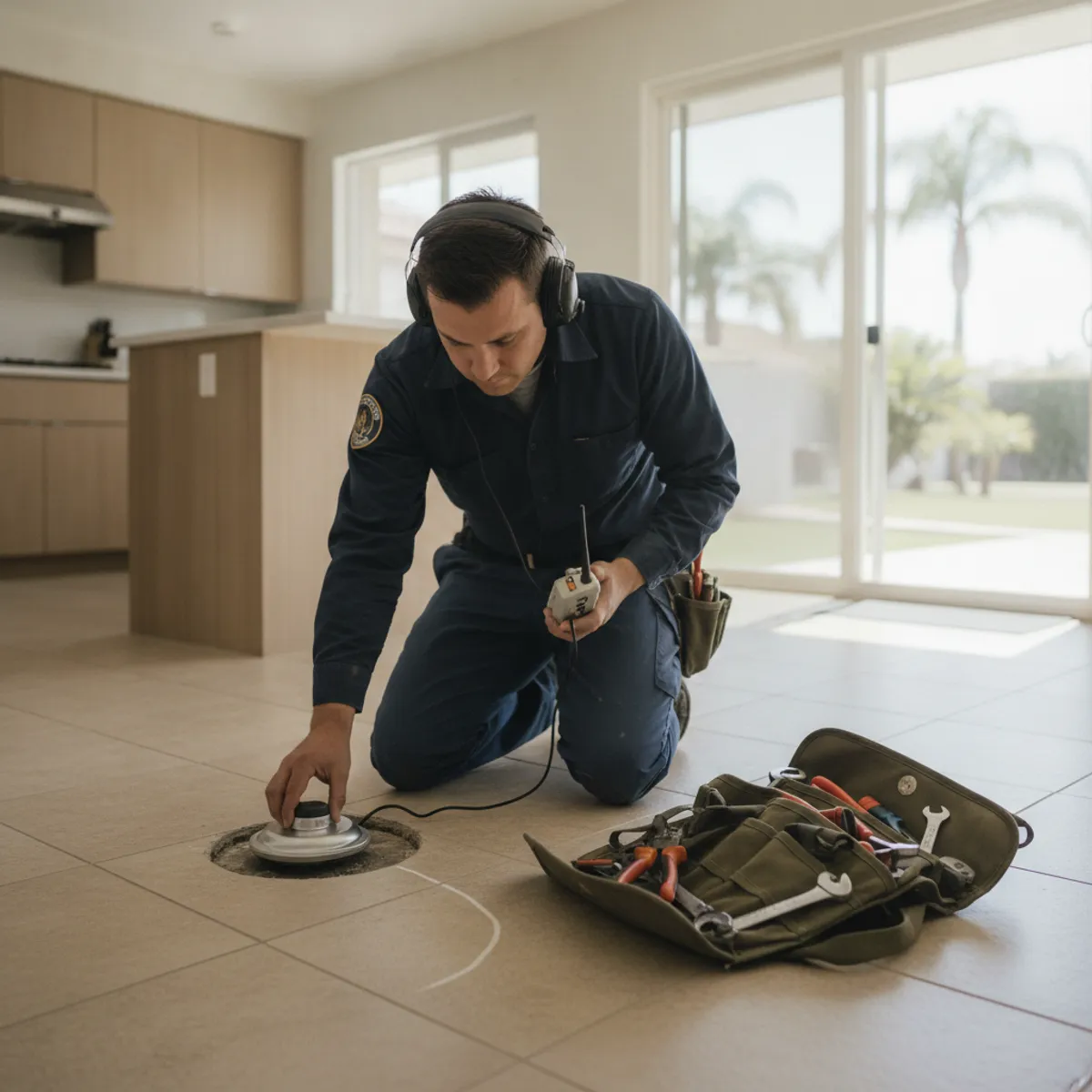
- Electronic location: We use electronic leak detection equipment to locate the source precisely. Highly sensitive acoustic listening devices let us hear water escaping under the slab, even through thick concrete.
- Thermal imaging: We may also use thermal imaging cameras to detect subtle temperature differences on the floor that reveal hot or cold water from a hidden leak.
- Tracer gas: In challenging cases, we might introduce a safe, non-toxic tracer gas into the lines, which can be detected as it escapes through the slab.
Finding the leak is only the first step, so Done-Rite prioritizes precision to save you time and money and avoid unnecessary damage to your property. Done-Rite charges no trip charge, offers a 1-hour response for urgent situations, and works on both slab and raised-foundation homes. Our guide to slab vs raised foundation plumbing explains how the two differ.
What comes after a slab leak is found?
After a slab leak is found, the next step is usually Slab Leak Repair. Slab leak repair at Done-Rite typically runs $500 to $3,000.
Done-Rite's leak detection work goes beyond pinpointing the problem to fixing the issue efficiently and restoring your plumbing system. For other hidden leaks in the home, our electronic leak detection services use the same technology to locate water leaks in walls, ceilings and other concealed areas.
Why is a slab leak worth checking early?
A slab leak that goes unaddressed keeps soaking the ground under the foundation, so the damage and the repair cost tend to grow over time.
A mysterious warm spot on the floor or a rising water bill is worth checking out before it turns into a plumbing emergency. If you suspect a slab leak in your Orange County home, Done-Rite Plumbing & Rooter is ready to help. Done-Rite is a family-owned business that brings professional tools and know-how together with personal, friendly service.
//Call us when
A warm spot on the floor, unexplained moisture at the slab edge, or a spinning meter.
If that's what's happening at your place, this is the right page. Call (714) 605-2950 and a real person will help you sort it out, or request a quote and our office will call you back.
What's included
- Pressure isolation of hot and cold lines to confirm the leak is under the slab
- Electronic detection, so the concrete only opens where it has to
- Slab leak repair runs $500 to $3,000, depending on location and access
Part of our leak detection department
Electronic leak detection that finds the leak before anyone opens a wall or slab. Slab and raised-foundation homes.
See all 3 leak detection servicesWhere we do this work
We run slab leak detection calls across Orange County from our shop in Anaheim, CA. No trip charge in any of these cities.
- Aliso Viejo
- Anaheim
- Anaheim Hills
- Brea
- Buena Park
- Costa Mesa
- Coto de Caza
- Cypress
- Dana Point
- Fountain Valley
- Fullerton
- Garden Grove
- Huntington Beach
- Irvine
- La Habra
- Ladera Ranch
- Laguna Beach
- Laguna Hills
- Laguna Niguel
- Laguna Woods
- Lake Forest
- Los Alamitos
- Mission Viejo
- Newport Beach
- North Tustin
- Orange
- Placentia
- Rancho Santa Margarita
- San Clemente
- San Juan Capistrano
- Santa Ana
- Seal Beach
- Trabuco Canyon
- Tustin
- Villa Park
- Westminster
- Yorba Linda
Leak Detection questions
Electronic leak detection finds the leak first, so the only thing that gets opened is the spot over it. We work both slab and raised-foundation homes.
A warm spot on the floor, the sound of running water with everything off, a water meter that keeps turning, a spike in your bill, or cracking and moisture at the edge of the slab.
It depends on your policy and your carrier. Ask your insurance company before the repair, and we'll tell you what we found and what we did.
$500 to $3,000, depending on location and access.
//Open 6am to 7pm daily · 24/7 emergency
Need slab leak detection?
Licensed, bonded and insured. Family-owned since 2014. No trip charge, 1-hour response, and 24/7 emergency service.